Saint Nicholas Cathedral of Monaco
Back to all places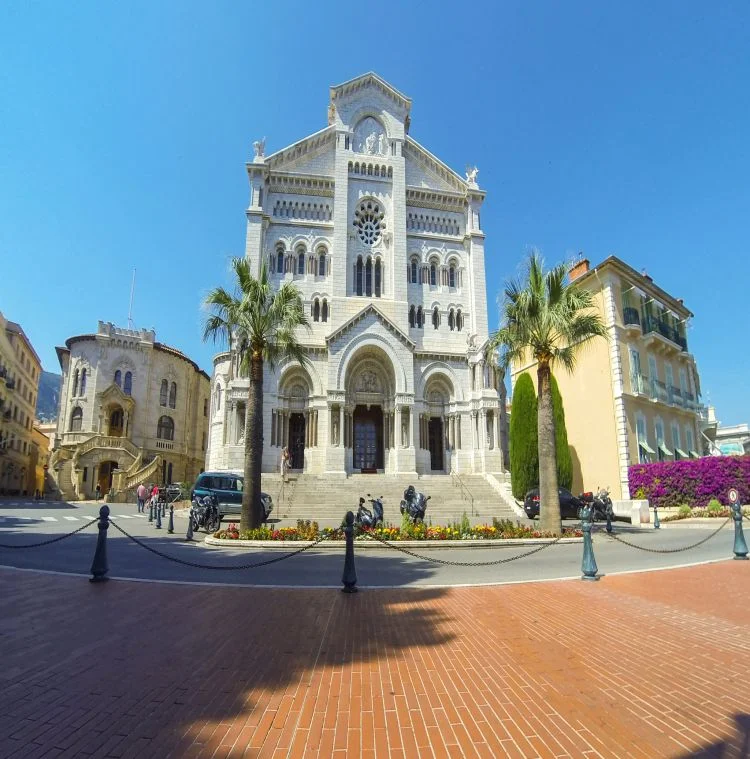
-
We have made it back to the other side of the Monaco, back to the glorious Mediterranean Sea on this side, and the royal cathedral on the other side. It is royal as it is around a 30 second walk away from the Palace, just up the alley over there – we have come on a long way round but we’re finally there, so you’re welcome.
-
This is where all the royal ceremonies take place – the coronations, weddings, funerals, baptisms, christenings. It is a lovely cathedral, but very dark – you can see that the windows are very small, designed in the Romanesque style, which keeps the interior dark and cool. It is a very meditative and soothing place, even if you are not religious – if nothing else, it is a way to get out of the sun.
-
At the back of the cathedral there is a semi-circle where all of the princes and princesses of Monaco are buried and right at the end is the gravestone of Rainier III and Grace Kelly – they are traditionally the only gravestones with flower arrangements on them. The locals go down to the Fontvieille Rose Gardens, where they pick flowers every day and bring them up to the Cathedral, where they create new arrangements every day in loving memory of arguably the best monarchs that Monaco has ever had. Both of them were very positive forces within Monaco – Grace Kelly on a domestic level, Rainier III on an international scale.
-
The cathedral is also dedicated to Saint Nicholas, who has now become our Christmas favourite Santa Claus or Father Christmas. Saint Nicholas was a Christian bishop who became famous for giving presents to the poor, which evolved into the modern day legend of Santa Claus who gives presents to everyone. Apparently, this is where Santa Claus comes on holiday – when he is tired of the North Pole, he comes here to Monaco to top up his sun tan. Santa ain’t no sucker.
-
The cream building off to the side of the Cathedral, where the spiral staircase is leading up to the doorway, is the Palais de Justice, a very important building within Monaco even if it is not particularly grandiose. It is far too important to be open to the general public, although you can go right up to the building, and in the walls you can see fossils and marine animals embedded into the architecture, which is symbolic of Monaco’s relationship with the sea.
-
The royal family is a little different to the other royal families around Europe – unlike the Queen of England or the King of Spain who exercise very little political power, the royal family of Monaco still has absolute power here. This system is called a hereditary constitutional monarchy, in which the royal family, in particular the ruling prince, has absolute power and can effectively do whatever they want. If Albert II wants something, it will happen; if not, it won’t. This is the only monarchy which exists in Europe that still functions in this way – it is very out-dated and antidemocratic. Most European countries have evolved and developed some form of democracy, whereas Monaco is still stuck in the 13th century with a 13th century form of rule.
-
There is a parliament made up of 24 elected members, although they act more like a board of advisors as they cannot do anything without the approval of the prince. The only shred of real power that they possess is the veto power. If they unanimously agree to reject a proposal by the prince, it will not go through. This is supposed to be the last stand against tyranny. Otherwise, the prince will sign off on every decision taken here in Monaco, even deciding who can qualify for Monegasque nationality – after the process of integration, the prince himself with personally accept or decline the request – as mentioned, the prince controls everything within this country.
-
For this reason, for Monaco’s status as a tax haven, as well as its problems with crime, Monaco is not part of the EU. Monaco does not have petty crime like theft or assault – think of expensive crime, like embezzlement, corruption or trafficking, crime that benefits the wealthy. Naturally, Monaco is reluctant to address these issues, which puts it at odds with the ideals of the EU. So the EU doesn’t want Monaco, and frankly, Monaco doesn’t want the EU. They have no interest in being standardised with the rest of Europe or being dictated from Brussels in Belgium about how to live – they are happy creating their own laws and regulations, as they always have done. They are rich enough to support themselves, and the idea of bailing out other countries is very unappealing to them, so there is no affiliation between the two entities.
-
The only link they have is a couple of benefits usually afforded to EU member states. If you bought anything today in Monaco, you would have paid in Euros as Monaco is part of the Eurozone – equally, it is possible to travel here by train from France without any passport control, as Monaco is also part of the Schengen Agreement which grants free travel without border control to EU states. The reason for these exceptions come from a position of convenience – around 80% of the workforce in Monaco commutes in from France or Italy every day. It makes a lot of sense, because in this way you can earn a Monaco salary while paying French rent, only taking a short 20-minute commute by train to work. Without these agreements, Monaco would need to check the documents of tens of thousands of people every day as they enter, as well as the tourists – this would be a massive scale operation for such a small scale country, so instead it has been considered as a Wider Territory of France, and has these few benefits given to it. Otherwise, Monaco and the EU exist separately to each other.
43.72994, 7.42239