Oceanic Museum of Monaco
Back to all places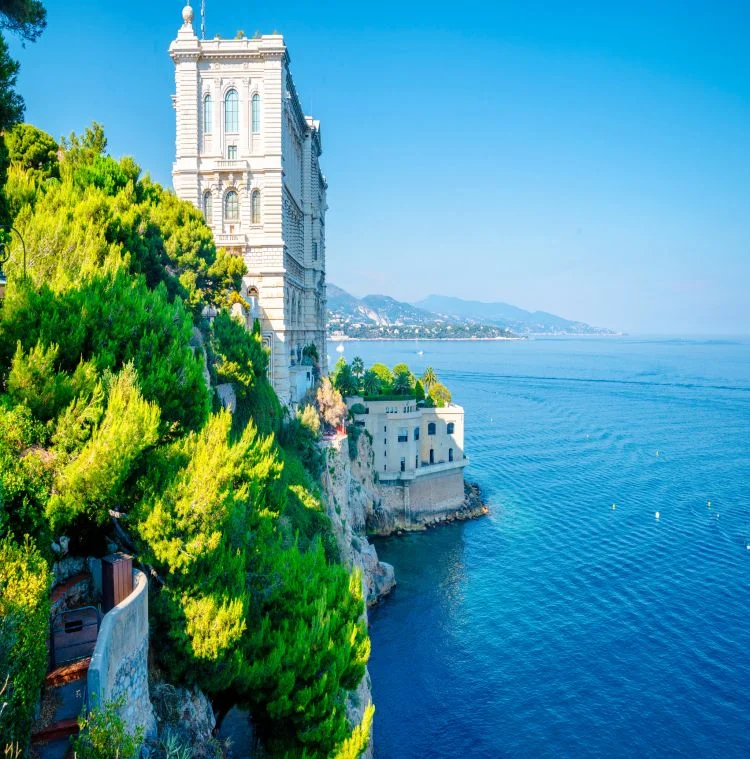
-
Behind you is one of the most magnificent buildings in the whole of Monaco. This is the Oceanic Museum, or the Musee Oceanographique, one of the most extensive and best aquatic museums across Europe. The architecture is stunning, being built right into the cliff face overlooking the Mediterranean Sea, and the sculpture work is exquisite – all around the building you can see all kinds of different marine animals – fish, jellyfish, walrus, whale, dolphin, octopus, crabs, lobsters, manta rays – a whole host of sea creatures.
-
This museum was set up by Albert I, the Prince of Monaco around a hundred years ago, in the 1910s and 20s. He was obsessed with the ocean and poured loads of money and funding into new ships, scientists and equipment to explore and analyse findings from the Mediterranean Sea and Arctic regions. The yellow submarine that you can see outside the doorway to the museum is one of the originals that they used to use to explore the waters – it looks like a glorified tin can, but again, this was a hundred years ago – before there were accurate maps of the ocean, obviously before the Internet existed, also before the Arctic regions had really been explored, so this was a massive period of breakthroughs and advances in marine science, and Monaco was one of the leading nations, with Albert I at the helm – he was particularly renowned in his field as a very accomplished marine scientist. And he wanted to display his findings to the Monaco people, and eventually to the public at large, so he set up this museum
-
Inside the museum, there is an aquarium on the bottom floor and on the right there is a turtle sanctuary. Upstairs there are a number of exhibitions – at the moment (time of writing August 2022) there is an immersive room experience which goes through the different cycles of the ocean, there is a whole area presenting Albert I’s work and specimens that he collected alongside other major breakthroughs in the realm of marine science, there is an exhibition about life would have been like on the ocean in the 1920s and a whole area dedicated to sustainability as well.
-
After Australia and Indonesia, Monaco is then the third biggest country that supports environmental protection, particularly regarding the oceans. Back in 1921, Albert gave a speech in Washington DC about the destructive effects of trawling the seas with ever more powerful ships that go further, deeper and faster – he was advocating for marine protected areas. Again, a hundred years ago; he was way before his time. Albert II now regularly donates hundred of millions of euros towards environmental protection, particularly the sea, particularly the Mediterranean. Monaco actually has what we call the Monaco Blue Band, which means that waters just off the coastline of Monaco are fiercely protected – this is why the water looks so clear and bright and beautiful; because it is some of the cleanest and healthiest water in Europe. You might have seen some fish in the Port Hercules as you were walking past it – this is fairly unusual, as port water is generally quite dirty; lots of oil and petrol and other waste is dumped straight out of the boats and into the water, which makes it very dirty and unsuitable for life. Monaco is a little different – as well as the extraordinary fees that these boats have to pay to moor here, they also have to follow a number of regulations that keep the water clean, which means that the sea life is not poisoned by human destruction – there are fish, crustaceans and even dolphins which live in these waters. This also keeps these waters very fertile for the fishing trade in Monaco – the only export from Monaco is fish, because their waters are so teeming with life. A lot of locals are fisherman by trade and go out in the morning to catch fish before going and selling them in the markets around the Cote d’Azur. Everything they take out of the water; Monaco replaces and replenishes 10 times. Monaco is expanding this enterprise further into the Mediterranean – if it were not for Monaco, the Mediterranean Sea would already be in a much worse condition, which is wildly impressive considering once again that Monaco is the second smallest country in the world.
-
So as mentioned, Monaco does have faults like embezzlement, corruption, and the dictatorial form of government, but it does have its moments as well, like both areas mentioned here. It is a forward-looking country, and both the education system and the environmental consciousness are ways that Monaco can maintain its position of wealth now as well as remain in control 10, 20 or 50 years from now. Both of these areas are specific to Monaco’s situation of size and wealth, but both are areas that other countries are now trying to implement into their own social fabric to become more educated and more sustainable, and therefore more successful.
43.73075, 7.42528